
All small batteries are potentially dangerous to children who access them. Ingestion by young children increasingly causes injuries and tragic fatalities.
A quick internet search on this topic will result in tragic stories from inconsolable, bewildered parents and horrific pictures of internal burns and the consequences of lethal chemical reactions inside the child’s body.
The highest risk occurs with lithium batteries having a diameter of about 20 mm.
This higher risk is caused by the facts that lithium batteries work at a higher voltage and due to their dimensions they are more likely to become stuck in a child’s oesophagus after ingestion.
Prevention includes creating awareness, adequate warnings and instructions, designing secure battery enclosures, keeping batteries out of reach of children, using child resistant packaging and immediate disposal of used batteries.
Coin or button?
Everybody knows and uses small round batteries. Based on the shapes of these batteries we call them “coin” or “button” interchangeably, regardless of the chemicals inside. But there is an important difference between them: Coin batteries contain lithium, button batteries do not.
Coin batteries (or cells) contain lithium chemistry and have a 3 Volt output.
The sizes of popular types of coin batteries can be derived from their coding: CR 2025 (20*2,5 mm), CR 2032 (20*3,2 mm) or CR 2450 (24,5*5 mm).
If these batteries get stuck in a child’s oesophagus then this leads to the most serious internal burns, which can result in chronic health problems or death unless there is immediate medical intervention.
Button batteries (or cells) do not contain lithium but for instance alkaline and have a 1,5 Volt output.
They are generally a bit smaller than coin batteries, for instance the popular LR44 alkaline battery is 11,6*5,4 mm. After these smaller batteries are ingested they travel through the gastrointestinal tract without causing significant problems in most cases. Only if they remain undetected in the oesophagus for a longer period, then the risks are comparable to that posed by lithium batteries especially for very young children. These children may also put small button batteries in ears or noses, damaging delicate tissues and causing serious injuries if undetected.
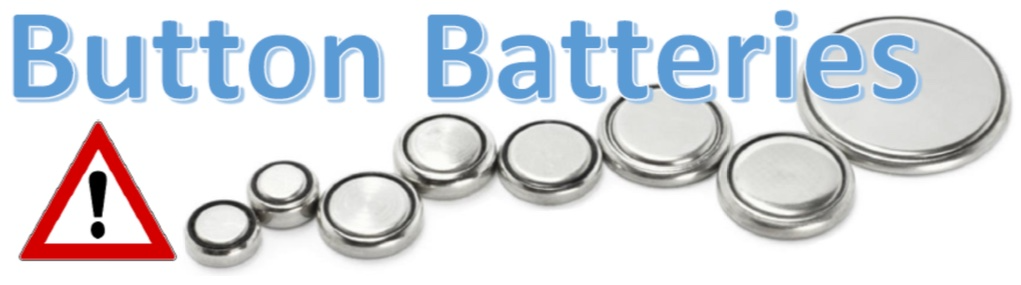
Image taken from European Portable Battery Association (EPBA) website https://buttonbatteryingestion.com
Warnings for toys with replaceable batteries
The safety of electric toys is dealt with by harmonised standard EN 62115.
The 2020 edition includes new warnings for toys using button batteries or coin batteries. The warnings are different for both types of batteries, that is why it is important to distinguish coin from button batteries.
Electric toys using replaceable coin (read: lithium) batteries shall carry the following warning on the packaging:
- Warning: Contains coin battery. Hazardous if swallowed-see instructions.
Alternatively, the packaging shall be marked with symbol ISO 7000-0790 and warning sign ISO 7010 W001 with a coin battery symbol. The two signs shall be placed next to each other and must be explained in the instructions.

(ISO 7000-0790)
 (ISO 7010 – W001);
 with coin battery symbol.
Electric toys using replaceable coin batteries shall state the following warning in the instructions:
- Warning: This product contains a coin battery. A coin battery can cause serious internal chemical burns if swallowed.
All electric toys using replaceable (coin and button) batteries shall state the following warning in the instructions:
- Warning: Dispose of used batteries immediately. Keep new and used batteries away from children. If you think batteries might have been swallowed or placed inside any part of the body, seek immediate medical attention.
Additional warnings
Standard EN 60086-4 deals with the safety of non-rechargeable lithium batteries provides the following example of an appropriate warning text:

Warnings for rechargeable batteries can be found in standards EN 62133-1 and EN 62133-2.
PAS 7055
BSI, the British Standards Institute, published standard PAS 7055 with safety requirements for button and coin batteries. It is a Publicly Available Specification (PAS) and although not an official British Standard it does provide information and guidance and is available for free: https://knowledge.bsigroup.com/products/button-and-coin-batteries-safety-requirements-specification.
Posters
You might want to download the posters provided by the UK’s Office for Product Safety and Standards (OPSS) with 5 top tips for parents to keep children safe:
- LOOK around your home for button batteries. Think toys, lights, remote controls and more.
- CHECK for products with loose backs and button batteries that have dropped out.
- STORE button batteries in a safe place, up high and out of your child’s reach.
- DISPOSE of used button batteries as soon as you can. They are still unsafe.
- ACT if you think your child may have swallowed a button battery, go straight to A&E or call an ambulance.
More information
The European Portable Battery Association (EPBA) is just one of the stakeholders that provides guidance on the safe use of batteries, visit their dedicated site on this topic: https://buttonbatteryingestion.com/en/
