
The French repairability index for electrical products
The Environmental Code is the French law that includes many obligations regarding ecodesign, fight against waste and on the circular economy. The repairability of products fits perfectly in those environmental objectives. The French Environmental Code requires information for consumers about the repairability of several products.
The principles of the repairability index for electrical products were introduced in Decree 2020-1757 of 29 December 2020. There is an accompanying Order of 29 December 2020 that provides further details on the pictogram, its colours and dimensions. And details on the parameters and methods to calculate the index, on a scale from 1 to 10.
A mandatory symbol applies to show the repairability index to consumers:
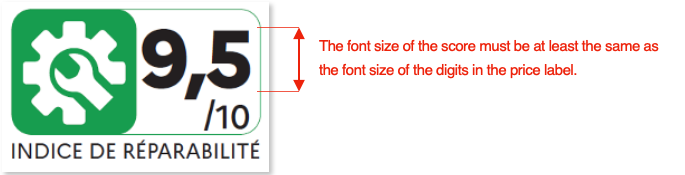
The colour of the ‘repair’ pictogram varies with the index score, there are 5 prescribed colours:

The Ministry of Ecological Transition provides professionals and the public with the documents essential for calculating and displaying the repairability index, including graphics, fonts, and pictograms.
Scope and timeline
The repairability index has been force since 1 January 2021 for mobile phones, televisions, portable computers, front-loading washing machines and lawnmowers (mains powered, cordless and robots).
In November 2022 the scope was extended to dishwashers, high pressure cleaners top-loading washing machines and vacuum cleaners (mains powered, cordless and robots).
Update: Durability index
In 2025, the Durability index replaced the Repairability index for televisions per 8 January and for washing machines per 8 April. This index introduces new criteria.
Obligations
Shops shall display the repairability index symbol visibly on or nearby the products being offered for sale. Webshops (distance sellers) shall display the repairability index visibly within the (online) presentation of the product and close to the price.
Sellers shall also provide consumers with the parameters (criteria) used to establish the repairability index.
Parameters
The repairability index is calculated from a combination of 5 main criteria; there are more sub-criteria (parameters).
The maximum score for each main criterion is 20, leading to a maximum sum of 100.
The final total score is then divided by 10, leading to a repairability index ranging from 1 to 10.
The following main criteria are defined in Decree 2020-1757:
- Documentation. The availability of technical documentation, instructions for use and maintenance instructions to producers, repairers and consumers;
- Disassembly. How easily the equipment may be disassembled: number of disassembly steps required for individual access to the spare parts, and characteristics of the required tools and the fastenings between the spare parts;
- Spare parts. The availability of the spare parts on the market and to the delivery times to producers, spare parts distributors, repairers and consumers;
- Price of spare parts. The ratio between the price of the parts sold by the manufacturer or importer and the price of the equipment sold by the manufacturer or importer (maximum 20);
- Product specific. Additional criteria specific to the category of equipment in question (also maximum 20).
The product specific legislation defines in much detail how the (sub)criteria should be scored and how the repairability index of the product is calculated.
An example of how Apple provides the parameter information and repairability index of their products can be found on their website: https://support.apple.com/fr-fr/circular-economy-repairability-indices.
