
Universal Serial Bus (USB)
USB is a highly common interface standard for data and power connections between a wide variety of electronics.
Since its introduction in 1996, connectors and technologies have evolved and continue to do so.
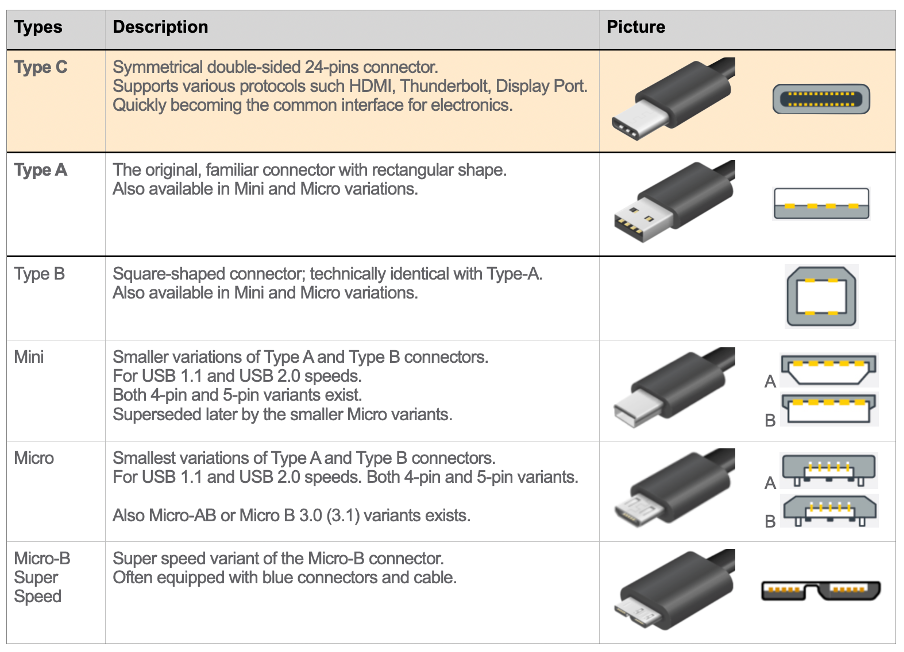
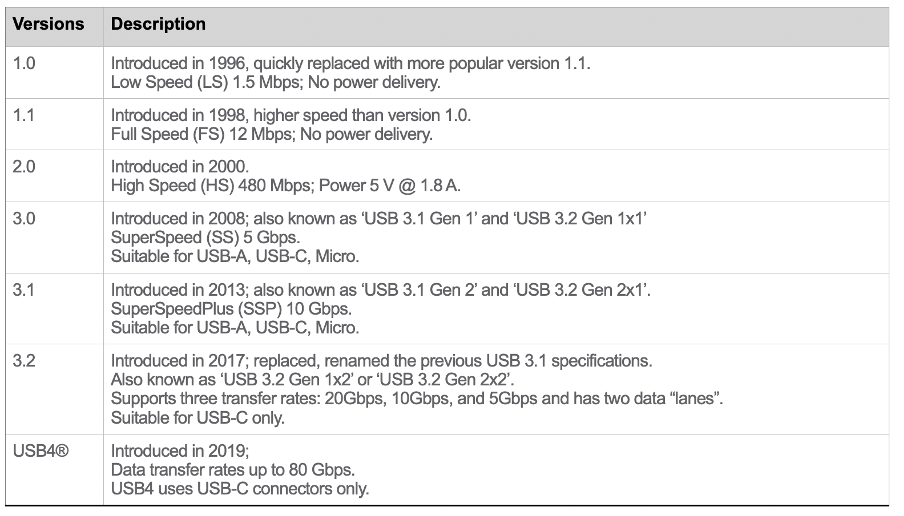
A non-exhaustive overview is given in the table below.
• Type refers to the shape of the connectors (first table);
• Version is used to describe the USB technology, and the highest data (second table).
Battery Charging 1.2
The Battery Charging 1.2 (BC) specification introduced a charging option for the USB port. The BC connection increases the maximum current of a standard USB port for faster charging. A normal USB 2.0 port provides up to 500mA (0.5 A) and a USB 3.0 port provides up to 900mA (0.9 A). A BC 1.2-compliant port provides up to 1.5 A, even while transferring data. Related standard is EN 62680-1-1 (previously EN 62680-3).
Power Delivery
Extension protocol for delivery of power levels ranging from 5 to 100 Watts (20 V @ 5 A.) over USB connections.
Make sure that the cable is capable of carrying the related currents.
Related standard is EN IEC 62680-1-2 .
Audio 3.0
The Audio Device Class Definition specifies how audio devices shall comply with USB. For analog and digital audio data (voice, sound) including volume and tone control.
Related standards are EN IEC 62680-1-5, -1-6, -1-7 and -1-8.
On-The-Go (OTG)
Published as a supplement to the USB 2.0 Specification, available from the USB Implementers Forum.
USB OTG is a specification that enables devices like smartphones to act as both hosts and peripherals.
This allows for functions like connecting USB flash drives, keyboards, or game controllers to a mobile device.
Colours
Some manufacturers use colour to indicate the USB type and version. Colours are not required by the USB standards and use of the colour varies between manufacturers. Blue cables and connectors is common for type A, version 3.
Mandatory markings
USB cables are used for the transfer of electrical currents (data, power) and meet the definition of ‘EEE’.
Therefore, CE marking is required according to RoHS Directive 2011/65/EU.
And “Waste EEE” marking (crossed-out recycle bin) is required according to WEEE Directive 2012/19/EU.
USB Symbols

The “Trident” symbol without additions can be used without a license, the same goes for the word “USB”.
There is a wide variety of other USB symbols, trademarks available that all require a logo trademark license agreement with the USB Implementers Forum (USB-IF): licensed logo’s.
