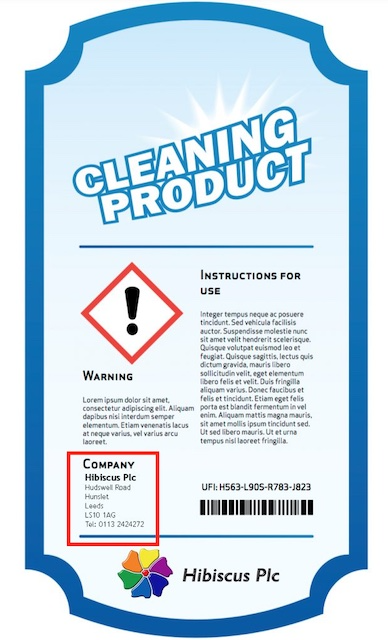
Traceability of goods
Traceability of goods is the ability to track goods and trace their history; trace a product through the whole or partial supply chain – from raw materials obtained via transport, storage, processes, distribution – to sale, or internally in one of the steps of the chain, through the production process. Traceability of goods is important from two perspectives:
- The regulators perspective; it makes an effective enforcement of legislation possible: by making it easier, through corrective measures, such as withdrawal or recall of products. Unsafe or non-compliant products can be traced through the supply chain.
- The manufacturers perspective; an effective control of the production process is possible. The product can be traced to manufacturers and the supply chain. In case of non-compliancy of a product, it enables manufacturers to reduce the impact of recalls or withdrawals: the better you know which exact product is impacted, the better you can manage the impact, the lower the costs.
The lawmaker has clearly described its objectives in the legislation. However, the legislation doesn’t specify how the objectives are to be met. In addition, the legislation is also ‘technology neutral’. This means that the regulator doesn’t prescribe the technologies to be used. Manufacturers may choose the traceability system which they deem most appropriate in relation to their products and their manufacturing and distribution system. The harmonisation legislation however does prescribe the minimum information to be provided.
Obligations for manufacturers
Manufacturers are obliged to:
- Display their name or registered trade name or registered trade mark.
- Display the address where the manufacturer can be contacted. It is also allowed to display the address of an authorised representative or of the customers services, as long as it is clear that there is a single contact point, in particular for market surveillance authorities. Note that the address of a website is not considered as address information.
- Furthermore, the manufacturer must ensure that his products bear a type, batch, serial number or other element allowing the product to be identified and traced.
The information must be displayed on the product. If this is not possible then the information is added to the packaging or to an accompanying document.
This would be the case when the size and/or the nature of the product makes the indication illegible or technically impossible. Aesthetic reasons do not fall under the exception.
Examples of products with this exception are:
- Hearing aids
- Sensors (or the like too small to carry information)
- Toys, consisting of several parts or an assembly of several parts, or due to its nature (such as plush toys)

Obligations for importers
You are considered as an importer when you place products from outside the EU onto the EU market. Importers are obliged to:
- Display their name or registered trade name or registered trade mark.
- Display the address where the manufacturer can be contacted, or when this is not possible, on the package or a document accompanying the package.
The term ‘contacted’ is important for the authorities. It however doesn’t necessarily mean the actual address where the importer is established, it can also be the address of a customer service.
Displaying a website is allowed, but does not replace the contact address: it’s considered additional information.
A few examples
- The manufacturer or brand owner is within in the EU; the product will only bear the address of the manufacturer (there is no importer involved).
- The manufacturer is outside the EU, products placed on the market by an importer; the product will bear 2 addresses (the manufacturer and the importer).
- Additional requirements may be applicable, for instance medical devices must also bear the authorised representatives name and address.
Obligations for economic operators
Economic operators have the obligation to be able to identify any economic operator who has supplied them with a product and to whom they have supplied a product. The obligation is set for a period of 10 years. The consumer (end-user) is not considered an economic operator. The legislation doesn’t provide rules on this obligation. It is consequently advised to comply to this obligation through relevant documentation, such as invoices. It is thus advisable to retain this information for a period of at least 10 years. These 10 years may be longer than required under accountancy legislation…
Obligations for identification of goods
In order to be able to identify a specific product, the product must, as a rule (see below), bear a type-number, batch number, serial or model number or another element allowing the product to be identified.
The manufacturer is given the freedom to choose the identification method most suitable to the product, as long as traceability is ensured.
The more specific the better?
Yes, in case of a recall or withdrawal from the market, all products with that specific identification must be recalled or withdraw. The better the identification, the least products affected, the lesser the costs will be.
What is a UFI-number?
The abbreviation UFI is short for Unique Formula Identifier. The UFI is an obligation for hazardous mixtures placed on the market.
Read more on this in the Unique Formula Identifier.
Need help with your packaging?
What information should be included on the product packaging and labelling in order to comply with applicable legislation? Through our label check service, you send us the packaging, artwork & manual per country, we will check applicable legislation. More information via this link.