
Get structured before the PPWR deadlines hit
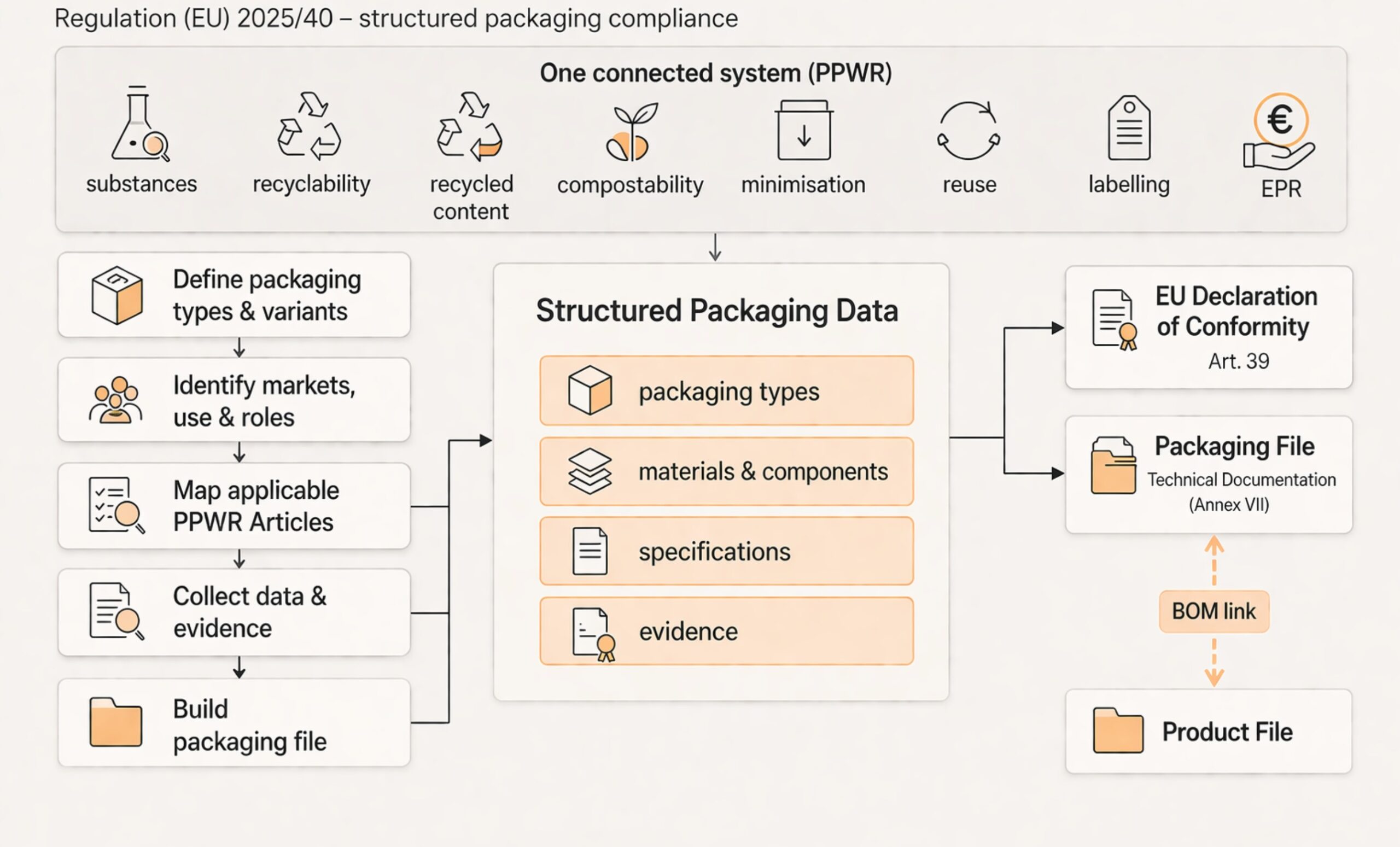
The Packaging and Packaging Waste Regulation (EU) 2025/40 (PPWR) is not a standalone recycling project. It connects substance requirements, recyclability, recycled content, compostability, minimisation, reuse, labelling, technical documentation, the EU declaration of conformity and EPR obligations into a single, coherent system.
Before placing packaging on the market, the manufacturer must ensure that all applicable requirements are met, the conformity assessment under Article 38 and Annex VII has been carried out, and the EU declaration of conformity under Article 39 has been issued. That only works if packaging data is managed in a structured way, not as a loose collection of documents.
Use a workable structure
A practical starting point is working through requirements packaging type by packaging type. First, define and separate packaging types and variants. Then identify markets, use contexts and roles in the supply chain. Next, map the applicable PPWR articles to each packaging type, build up the data and evidence, and bring everything together in a solid packaging file.
The value of this structure becomes clear quickly for packaged products: an outer carton, an EPS insert and an accessory bag within the same packaging set may each be subject to different requirements and different evidence. When product, packaging, supplier, version and market release do not change at the same time, a single mixed dossier becomes error-prone fast.
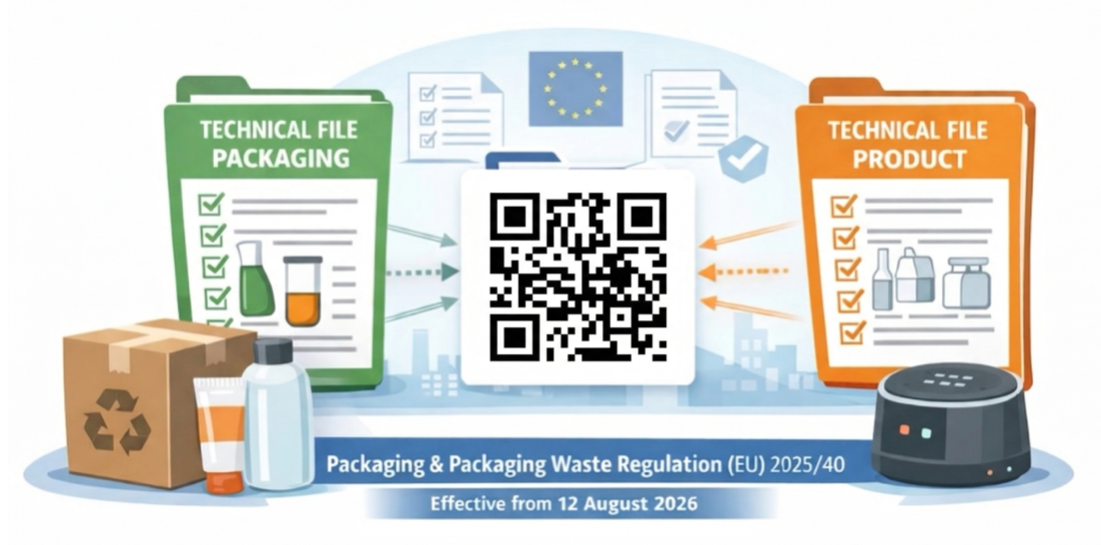
For packaged products, a model with separate but linked files is often more robust: a packaging file for the packaging-specific compliance (including the EU declaration of conformity for the respective packaging type), and a product file for the product-related compliance. A structured link between the two, for example a BOM reference, allows both to be joined for the relevant market and release context.
Please start early
Some requirements apply from 12 August 2026, including the general recyclability obligation under Article 6(1) and the PFAS limits for food-contact packaging under Article 5(5). Others kick in from 2028, 2030 or later, but the underlying data and assessments need to be in place earlier. Getting the PPWR structure right from the start also reduces friction later on labelling, artwork approval, change management, EPR reporting and digital information obligations.
Anyone who starts just before the Regulation begins to apply will most likely find that packaging data, product relationships and supporting evidence are rarely where they would ideally like them to be.
An overview of the PPWR Guidance series
This guidance series reflects the state of Regulation (EU) 2025/40, Commission Notice C(2026) 2151 final and FAQ DG ENV of March 2026.
The series comprises eleven articles and provides a step-by-step guide to the practical implementation of the PPWR, from scope and context to recyclability, recycled content, labelling and technical documentation, through to EPR and producer obligations. The series is supplemented by a separate article on deadlines, providing an overview of the most important deadlines and dates of application.
1. Clarify scope and context first
Many PPWR projects do not fail on recyclability, recycled content or labelling. They fail much earlier – because it was never clearly established which packaging is being assessed, which component needs separate treatment, which markets are affected and what role the company plays in the relevant chain of obligations.
There is a definition of ‘packaging’
Article 3(1)(1) defines packaging as: any item, regardless of material, that an economic operator uses to contain, protect, handle, deliver or present products. What matters is the function and intended use, not the material alone. Annex I provides a non-exhaustive indicative list, but being on that list is not enough. It always needs to be checked whether the definition criteria are actually met.
Not every object that holds a product is automatically packaging. Medical (In-Vitro) bags and syringes, for example, are not packaging, they are integral parts of the medicinal product itself. Plant pots in which a plant is sold at the final stage of production are packaging; pots used only within a nursery’s production cycle are not.
Clearly define the assessment
In practice, it is not enough to speak of ‘the packaging’ as a single whole. Working by assessment object or packaging type is more useful. A packaging unit may consist of a main body and separate components that need to be treated differently under the regulation.
Article 3(1)(45) defines a packaging unit as a unit that, including all integrated or separate components, serves a packaging function as a whole.
Integrated components (Article 3(1)(43)) are disposed of together with the main structure.
Separate components (Article 3(1)(44)) must be fully and permanently separated to access the product, a distinction that matters for recyclability assessment, among other things.
There are three roles that shall not be confused
The manufacturer in the conformity sense is responsible for the technical documentation and EU declaration of conformity. This is generally the person who has had the packaging or packaged product designed or manufactured under their own name or trademark. Exception: if that person is a micro-enterprise (fewer than 10 employees, annual turnover or balance sheet total not exceeding EUR 2 million under Recommendation 2003/361/EC) and the supplier is in the same Member State, then the supplier becomes the manufacturer (Articles 3(1)(13) and 15).
The supplier provides specifications, material data, technical declarations and test reports, but is not responsible for the EU declaration of conformity (Article 16).
The producer, as defined under extended producer responsibility (EPR), is market-specific. What matters is who first makes packaging or packaged products available in a Member State. This role is separate from conformity responsibility and must be assessed per Member State (Article 3(1)(15))
Answer questions before the assessment
Before any substantive review, the following questions should be answered for each packaging type:
- Is there food contact?
- Does the packaging contain plastic, and if so, in which components?
- Is it sales, grouped, transport or e-commerce packaging?
- Are there reuse, refill or claim contexts?
- Is the packaging placed on the market empty or with a product?
Without these answers, even good test reports and supplier declarations have limited value.
And have a close look at the requirements in Chapters II (Sustainability), III (Labelling) and V (Excessive packaging).
2. Substances of Concern
The general obligation to minimise substances of concern (SoC) in packaging applies from 12 August 2026.
PPWR Article 5 contains substance obligations that need to be assessed.
Substances of Concern come from ESPR
The Framework Regulation with Ecodesign requirements for Sustainable Products, ESPR (EU) 2024/1781, introduces Substances of Concern.
The PPWR refers to Article 2(27) of ESPR. A substance is a SoC if it has specific hazard properties under CLP (e.g. carcinogenicity, mutagenicity, PBT/vPvB properties) or if it negatively affects recycling or reuse. Only one of these conditions needs to be met. A finalised list of SoC in packaging does not yet exist, the Commission and the EUropean Chemical Agency (ECHA) are conducting a study.
The heavy metal limits are the same as before
The combined concentration of lead, cadmium, mercury and hexavalent chromium in packaging or packaging components must not exceed 100 mg/kg (Article 5(4)). This is the same as in the current packaging directive.
Few specific exemptions exist, Commission Decision 2001/171/EC provides a still-valid exemption for glass packaging where the exceedance results from added recycled cullet and no heavy metal is intentionally introduced during manufacturing. The Commission may only lower this limit by delegated act, not raise it.
PFAS limits apply for food-contact packaging
From 12 August 2026, food-contact packaging may not be placed on the market if it contains PFAS at or above the following concentrations: 25 µg/kg (ppb) for any individual PFAS; 250 µg/kg (ppb) for the sum of all PFAS; 50 mg/kg (ppm) for total fluorine. The limits apply to both intentionally added and unintentionally present PFAS.
There is no transitional period for stock: packaging placed on the market before 12 August 2026 does not need to be withdrawn. Packaging placed on the market from that date onwards must comply, regardless of recycled content.
The Commission recommends a stepped testing approach (Commission Guidance, point 5):
- Step 1: total fluorine (TF). If TF is below 50 mg/kg, the sample can be considered compliant.
- Step 2: if TF exceeds 50 mg/kg, determine organic fluorine (pyrolysis-GC/MS).
- Step 3: if organic fluorine also exceeds 50 mg/kg, run a direct TOP analysis for the 25 ppb and 250 ppb limits. No harmonised EU test methodology exists yet, but total fluorine testing is commercially available.
Chemical assessments are a challenge
Generic compliance statements are not sufficient. The technical documentation shall clearly identify which component, layer or material version the assessments refer to. Coatings, barrier layers, printing inks, adhesives, lacquers, additives and food-contact layers all need specific attention. The supplier can provide material declarations, SoC declarations, food-contact statements, test reports and material specifications. But the assessment of whether Article 5 is satisfied remains with the manufacturer. An assessment is only reliable when evidence is clearly assigned to specific components or layers.
3. Design-for-Recyclability and Recycled-at-Scale
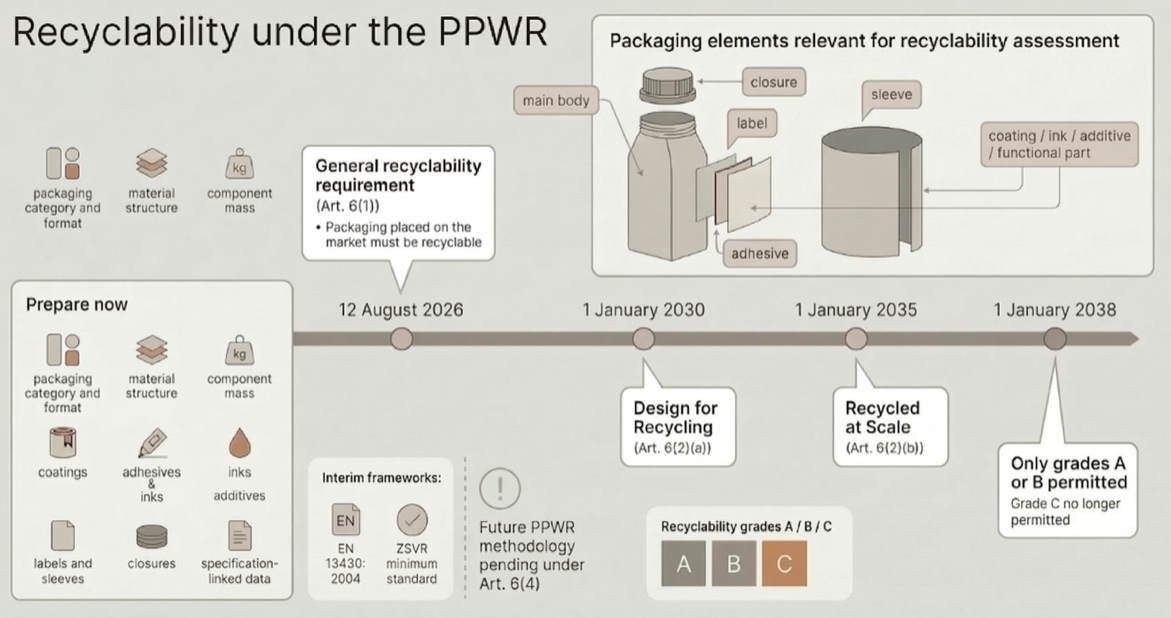
Article 6(1) requires all packaging placed on the market to be recyclable. This applies from 12 August 2026.
What that means in practice, and how to demonstrate it, depends on the downstream requirements of Article 6.
The timeline of requirements
Article 6(2) sets out two conditions for packaging to be considered recyclable:
A) Design for Recycling
Packaging must be designed for material recycling. This applies from 1 January 2030, or 24 months after the delegated acts under Article 6(4) enter into force, whichever is later. The Commission must adopt those acts by 1 January 2028.
B) Recycled at Scale
When packaging becomes waste, it must be recyclable at scale. This applies from 1 January 2035, or five years after the implementing acts under Article 6(5) enter into force, whichever is later.
Until the delegated acts under Article 6(4) enter into force, manufacturers are bound by the recyclability requirement of the PPWD and EN 13430:2004. A formal conformity assessment under Article 38 and Annex VII is not required for recyclability until after those delegated acts have entered into force. This is explicitly confirmed in Commission Guidance, point 6.
There are three Recyclability Performance Grades
The PPWR works with Recyclability Performance Grades A, B and C. Once the DfR requirements apply, only packaging achieving grades A, B or C may be placed on the market. From 1 January 2038, only A or B will be acceptable. The exact methodology for grading has not yet been published, it will be set out in the delegated acts under Article 6(4). This is an open point.
These exemptions from recyclability exist
Article 6(11) exempts certain materials for sales packaging, including cork, lightweight wood, textile, rubber, ceramics, porcelain and wax. These packaging types do not need to go through the recyclability assessment for market access purposes. For Extended Producer Responsibility (EPR) purposes, however, recyclability is still assessed to determine eco-modulation of EPR fees. The Commission will review these exemptions by 1 January 2035.
What to prepare now
Even without harmonised DfR criteria, structured data collection makes sense. Relevant information includes: packaging category and format; material structure of the main body; mass of all components; DfR-relevant parameters such as coatings, adhesives, printing inks, additives, labels, sleeves, closures and functional parts; and clear assignment of all data to specific components and specifications. Existing frameworks such as EN 13430:2004 or the German ZSVR minimum standard 2025 can serve as guidance, but they are not a substitute for the future PPWR methodology.
4. Recycled Content and Bio-based Plastics
Recycled content and bio-based plastics are two separate regulatory paths. The PPWR treats them differently. Different obligations, different legal consequences, different data requirements. Mixing them up is an operational risk. They have their own Article in PPWR.
Minimum recycled content in plastic packaging
Article 7 sets minimum recycled content requirements for specific categories of plastic packaging. They apply from 1 January 2030, or three years after the implementing act under Article 7(8) enters into force, whichever is later. The Commission must adopt that implementing act by 31 December 2026.
Recycled content is calculated as an average per manufacturing plant per calendar year (plant-year average). The calculation is done at facility level, not at the level of individual packaging units. Each manufacturing plant must separately demonstrate that the annual average for each packaging type and format meets the minimum requirements.
Exemptions can be found in Article 7(5)):
- Plastic parts representing less than 5% of the total weight of the packaging unit;
- Food-contact plastic packaging where recycled content would pose a health risk and result in non-compliance with REACh regulation (EC) 1935/2004;
- Adhesives, paints and inks are not classified as plastic and fall outside the recycled content requirements.
By 1 January 2028, the Commission must assess whether further exemptions are needed for food-contact plastic packaging other than PET (Art. 7(12)), relevant for many packaging applications, as authorised recycling technologies for those polymers are not yet available.
Bio-based plastics
Article 8 does not currently create any general obligation to include a minimum share of bio-based raw materials. It provides for a Commission review, potentially followed by a legislative proposal.
In practice, Article 8 becomes relevant when companies want to specify, purchase, promote or label bio-based plastic content, in which case the environmental claims requirements under Article 14 apply.
Keep the assessment paths separate
Recycled content and bio-based raw materials must be tracked and documented separately.
For recycled content: weight per relevant plastic component, plant-year average, origin of recyclate and document references.
For bio-based raw materials: separate records covering which component is affected, evidence that bio-based feedstock is actually used, how the share was determined and what evidence is available.
This separation prevents errors in claims, labelling and technical documentation.
5 .Compostability, Minimisation and Empty Space
These are three areas where marketing language and legal reality are often far apart. The PPWR ties all three to specific conditions, clear legal consequences, and staggered deadlines.
Compostability
Article 9(1) makes industrial compostability mandatory for certain packaging formats from 12 February 2028.
These include: permeable tea, coffee or other beverage bags and soft-after-use single-serve units (Article 3(1)(1)(f)); certain lightweight and very lightweight plastic carrier bags; and stickers for fruit and vegetables.
Non-permeable machine capsules (Article 3(1)(1)(g)) are not subject to Article 9(1). Individual Member States may require compostability for those formats under Article 9(2), but metal capsules are explicitly excluded from that option.
For all other packaging, the recyclability logic under Article 6 applies. Compostability is not a general environmental bonus.
The Commission has requested CEN to develop a new EU-wide standard on home compostability by 12 February 2026. Until a new harmonised standard is in place, EN 13432:2000 can serve as guidance for industrial compostability, but does not create a formal presumption of conformity.
Minimisation
Article 10 – From 1 January 2030, the weight and volume of packaging must be reduced to the minimum necessary for functionality (Article 10(1)).
Design features whose only purpose is to increase the perceived volume of the product, double walls, false bottoms, unnecessary layers, are prohibited (Article 10(2)).
Marketing considerations and consumer acceptance alone do not justify additional packaging weight or volume (Recital 60).
Until end of 2029, the essential requirements of the PPWD and EN 13428:2004 remain in force as a transitional standard (Article 70(1)(b)).
The Commission must request CEN to update this standard by 12 February 2027.
Exemptions
Article 10(2) – packaging designs protected by registered Community designs or trademarks (protected before 11 February 2025, where applying the minimisation rules would affect the protected element) and packaging for products with a protected geographical indication under EU law are exempt.
Empty space
Article 24 – For grouped, transport and e-commerce packaging, the empty space ratio must not exceed 50% from 1 January 2030. The calculation methodology will be set by implementing act by 12 February 2028. The responsible party is the economic operator who fills the packaging, not necessarily the manufacturer in the conformity sense. For sales packaging, Art. 10 applies without a fixed percentage threshold; the manufacturer is responsible for documenting compliance.
6. Reusable and Refillable
Under the PPWR, reuse is not just a product feature. What matters is not whether packaging could theoretically be used more than once, it is whether it actually circulates multiple times within a functioning system. That is why reuse and refillable systems need to be documented well.
When packaging qualifies as reusable
Article 11 – The criteria apply from 11 February 2025. Packaging placed on the market before that date does not need to be brought into retroactive compliance (Article 15(9)). Market surveillance can check conformity only from 12 August 2026.
Reusable packaging must, among other things:
- Be designed and conceived for multiple rotations without losing its ability to perform its intended function;
- Be capable of being emptied, unloaded, refilled or reloaded without affecting product quality, safety or hygiene;
- Be capable of being reconditioned in accordance with Annex VI, Part B; and
- Meet the recyclability requirements of Article 6 so it can be recycled when it reaches end of life.
The Commission must adopt a delegated act setting minimum rotation numbers for commonly used reuse formats by 12 February 2027.
Reuse targets for transport packaging
Article 29 – From 1 January 2030, economic operators using pallets, foldable plastic boxes, crates, trays, IBCs, pails, drums and canisters (in any size or material, including pallet wrappings) must ensure that at least 40% of that packaging is reusable within a reuse system. For transport between an operator’s own sites or between linked enterprises, and for deliveries within the same Member State, a 100% requirement applies from 1 January 2030 (Article 29(2) and (3)).
Exemptions
Article 29(4) mentions the following exemptions:
- Packaging for dangerous goods under Directive 2008/68/EC;
- Custom-designed packaging for large-scale machinery and equipment;
- Cardboard boxes (including corrugated cardboard);
- Flexible formats in direct contact with food or feed.
What a sound reuse system requires
Documenting reuse means combining packaging data with system data.
Packaging data covers material, construction, robustness, intended function and hygienic suitability.
System data covers the return process, cleaning, inspection, refilling or reloading, tracking solution and the intended minimum number of rotations.
Keeping these two sets of data clearly separated makes labelling, digital information and evidence requirements easier to manage.
Labelling requirements for reusable packaging
Reusable packaging must be labelled as reusable and carry a QR code or other standardised open data carrier from 12 February 2029 (or 30 months after the implementing act under Art. 12(6) enters into force, whichever is later).
The data carrier must provide information on reusability, collection points, and tracking of rotations or an average estimate.
Open loop systems without a system operator are exempt from this labelling requirement and from the rotation reporting obligation.
7. Labelling, QR Codes and Digital Information
PPWR labelling is more demanding than it first appears. Physical labels, QR codes, digital information, harmonised EU specifications, reuse requirements and interfaces with product law all come together.
Harmonised pictograms for material composition
Article 12(1) – From 12 August 2028, or 24 months after the implementing act under Article 12(6) enters into force (whichever is later), packaging must carry harmonised pictograms showing material composition to help consumers sort waste correctly.
Not applicable to: transport packaging (except e-commerce packaging); packaging for human or veterinary medicines, medical devices and in vitro diagnostics used exclusively by professional users; and packaging covered by deposit and return systems.
Article 12 is fully harmonised. Once the harmonised requirements apply, Member States can no longer enforce national labelling requirements alongside the EU pictograms.
Note: Parts of the harmonised labelling framework are still subject to further EU implementing rules. This article reflects the current state and will be updated once the final specifications are in place.
Commission Decision 97/129/EC remains valid until 12 August 2028.
Reusable packaging
Article 12(2) – Reusable packaging must be labelled as reusable and carry a QR code or other standardised open data carrier from 12 February 2029. National labelling rules may remain alongside EU requirements until that date.
Voluntary label for recycled and bio-based content
Article 12(4) – Operators may voluntarily label the share of recycled or bio-based material. If they do, they must use the EU harmonised specifications. This voluntary label is harmonised from 12 August 2028.
Digital information requirements
Article 12(5) – Information must be visible, legible and understandable for end users.
If provided digitally: data collection only for the purpose of access; no mixing of compliance information with sales or marketing content. Where another Union act also requires a data carrier on the packaged product, a single data carrier should be used for both product and packaging information, with the two areas remaining clearly distinguishable.
This does not mean merging all data indiscriminately. A practical approach is a shared compliance data carrier linking to a page where product and packaging information are clearly separated but connected through the specific product-packaging relationship.
When to start the labelling process
The labelling process does not start in the artwork. It starts with scope, data model and governance: which obligations apply; where the content comes from; who approves it; how language requirements are handled per market; and how digital provision is managed for online retail before purchase. The implementing acts specifying exact pictogram specifications are due by 12 August 2026.Technical documentation and Declaration of Conformity
8. Technical documentation and Declaration of Conformity
The technical documentation and EU declaration of conformity are formal proof that the process was run properly. They are not a formality at the end, they are the foundation of compliance.
The required documentation
Article 15(1) requires the manufacturer to ensure, before placing packaging on the market, that the packaging meets all applicable requirements under Articles 5 to 12.
And that the related technical documentation has been drawn up in accordance with Annex VII.
Article 39 demands that the EU declaration of conformity has been issued.
The conformity assessment may be carried out by the manufacturer or delegated to a third party (e.g. a laboratory or certification body). The EU Declaration of Conformity, however, must be issued by the manufacturer, who bears sole legal responsibility for packaging compliance, regardless of who actually drafted the declaration.
The contents of the EU Declaration of Conformity
A written EU declaration of conformity is drawn up for each packaging type.
It must clearly identify the packaging type it covers, reference the technical documentation, and include the date, manufacturer details and signature.
A single declaration covering multiple Union acts is permitted (Article 39(3)), but packaging and product conformity must remain clearly distinguishable within it.
For identifying the packaging (Annex VIII), a type, batch or serial number or any other suitable identifier is sufficient, the manufacturer may choose freely.
What the technical documentation achieves
The technical documentation demonstrates why a specific packaging type meets the applicable requirements.
Annex VII sets out what it must contain depending on the applicable requirements.
Typical elements include:
- Clear identification of the packaging type and its variants;
- Description of the design, drawings or specifications;
- Weight, volume, material ratios and components;
- Evidence on substance requirements, recyclability, recycled content, compostability, labelling and reuse, where applicable;
- Methods, standards and specifications used.
The conformity assessment must cover the entire packaging unit, including all integrated and separate components.
Retention periods and obligations towards authorities
Technical documentation and EU Declarations of Conformity must be kept for at least five years after placing on the market for single-use packaging, and at least ten years for reusable packaging.
They must be made available to national market surveillance authorities on request.
Single Declaration for product and packaging
For packaged products with multiple conformity obligations, a model with separate but linked files is often the most robust approach: a packaging file for packaging-specific documentation, and a product file for product-related conformity logic.
A structured BOM link brings the two together in the relevant market and release context.
9. Extended Producer Responsibilities
Producers have extended responsibilities and obligations such as registration, authorised representatives, reporting and involvement of Producer Responsibility Organisations (PRO).
This is not a back-office task. It is a market-specific set of obligations with its own logic, its own timeline and its own data requirements.
Producer and manufacturer: two separate roles
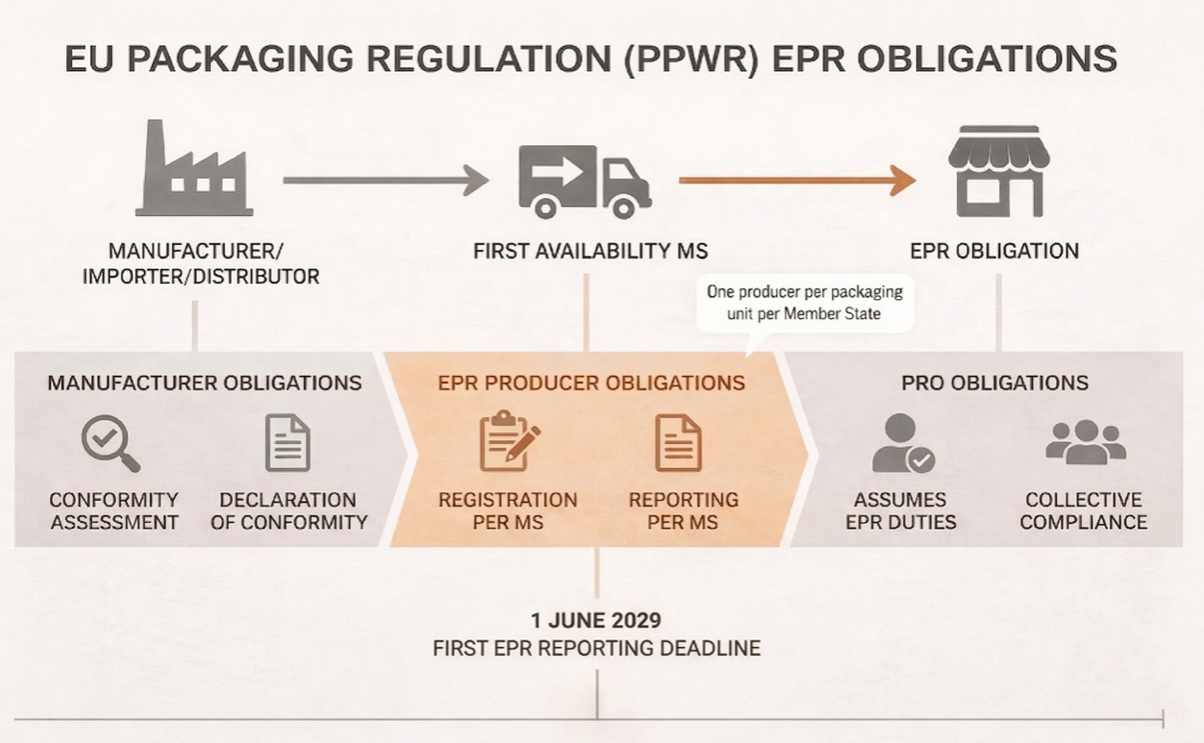
The producer in the extended responsibility is the manufacturer, importer or distributor who first makes packaging or packaged products available in a Member State (Article 3(1)(15)).
What matters is where the packaging is first made available, not where the company is based. For online sales, offering a product directly to an end user in another Member State counts as first making available in that Member State. There should be only one producer per packaging unit per Member State.
Importers and branches
A branch without its own legal personality does not qualify as an importer under the PPWR. If no EU-incorporated importer exists, an authorised representative under Article 17 must be appointed.
Importers and distributors as manufacturers
Importers and distributors normally carry their own obligations under Article 18 and Artcile 19 but are not the manufacturer in the conformity sense.
Article 21 overrides this in two situations: where they place packaging or packaged products on the market under their own name or trademark, or where they modify packaging already on the market in a way that may affect compliance.
In either case they take on the full manufacturer’s obligations, compliance with Articles 5 to 12, technical documentation under Annex VII and the EU declaration of conformity under Article 39.
Private-label sourcing and any repackaging or component change that affects recyclability, composition or labelling are the most common triggers. Changes that are purely administrative, a local-address sticker, a barcode, do not trigger Article 21; the technical documentation should record the rationale where the line is not obvious.
Article 21 does not affect the EPR role. Who is the producer in the EPR sense (Art. 3(1)(15)) is assessed separately per Member State, the two roles do not automatically coincide.
Authorised representatives
Article 17 – Manufacturers may appoint an authorised representative for issuing the EU declaration of conformity and other obligations under Article 17.
Article 45 – In the EPR context, an authorised representative under Article 45 can take on EPR obligations in a Member State where the producer is not itself established.
Register and reporting
Article 44 – All producers must register in the Member State where they first make packaging available. The Commission must adopt the implementing act on the register format by February 2026. Member States must set up their registers 18 months after that act. Producers must report for the first time by 1 June 2029 under the harmonised rules, covering the year 2028. Producers placing less than 10 tonnes of packaging per year and Member State face reduced reporting requirements. There is no general exemption from EPR obligations for micro-enterprises.
Producer Responsibility Organisation
Article 46 – Producers may join a Producer Responsibility Organisation (PRO) that takes on EPR obligations on their behalf.
Online platforms may pay EPR fees on behalf of producers, but are not responsible for registration or reporting unless the producer has specifically appointed the platform as an authorised representative (Article 45(4)).
Building the EPR process
A well-structured packaging dataset can support the EPR data foundation. It does not, however, replace the per-Member-State role assessment or the market-specific register and reporting logic.
What matters per Member State: the role of the obligated company; registration status and number; authorised representative for EPR if applicable; PRO used; reported quantities and packaging categories; and the period logic, granularity and auditability of reported data.
10. Deadlines and Timelines
The obligations and requirements in the Packaging and Packaging Waste Regulation do not apply all at the same time.. Obligations, bans and targets are phased in over roughly 15 years, some at fixed dates, others depending on when the Commission adopts still-pending delegated or implementing acts. The table below gives a complete overview of all key deadlines.
Deadlines tied to still-pending delegated or implementing acts are marked with *. The later date is always decisive.
| Date | Requirement / Obligation | Notes |
| 11 Feb 2025 | PPWR entered into force | Regulation (EU) 2025/40 takes effect. Criteria for reusable packaging under Article 11(1) apply from this date. Packaging placed on the market before this date does not need to be brought retroactively into compliance (Article 15(9)). |
| 31 Dec 2025 | Member States report on substances of concern | Member States inform the Commission of relevant information on Substances of Concern in packaging (Article 5(2)). Input for the ongoing ECHA study. |
| 12 Feb 2026 | Commission requests home compostability standard from CEN | Commission mandates CEN to develop a new EU-wide home compostability standard (Article 9(6)). |
| Feb 2026 | Commission implementing act: EPR register format | Commission adopts the implementing act on the format for EPR registration and reporting (Article 44(14)). Member States must set up their registers 18 months after this act. |
| 12 Aug 2026 | General application date of the PPWR | Article 71: the PPWR applies in full, unless specific individual dates apply. Obligations under Article 15 (Manufacturer), Artcile 18 (Importer) and Article 19 (Distributor) become enforceable. Market surveillance may check conformity. |
| 12 Aug 2026 | PFAS limits for food-contact packaging | 25 ppb (individual PFAS), 250 ppb (sum of PFAS), 50 ppm (total fluorine). No transitional stock period: all food-contact packaging placed on the market from this date must comply. PPWR Article 5(5). |
| 12 Aug 2026 | SoC minimisation obligation; heavy metal limit 100 mg/kg | General obligation to minimise SoC in packaging and emissions. Sum of Pb + Cd + Hg + Cr(VI) max. 100 mg/kg. PPWR Articles 5(1) and 5(4). |
| 12 Aug 2026 | Basic recyclability obligation | All packaging must be recyclable. Until the delegated acts under Article 6(4) enter into force, EN 13430:2004 under the PPWD applies. Formal conformity assessment under Article 38 not yet required for recyclability. |
| 12 Aug 2026 | Commission implementing act: Labelling specifications | Commission adopts implementing act with harmonised pictograms and specifications for labelling under Articles 12(1), (2) and (4) (Art. 12(6)). Pending at time of writing. |
| 31 Dec 2026 | Commission implementing act: Recycled content calculation | Commission adopts implementing act on the calculation and verification of recycled content and on the format of technical documentation (Article 7(8)). Pending. |
| 12 Feb 2027 | Commission delegated act: Minimum rotations for reusable packaging | Commission sets minimum number of rotations for commonly used reuse formats (Article 11(2)). Foundation for product design and technical documentation for reusable packaging. |
| 12 Feb 2027 | Standardisation request on minimisation to CEN; Annex V guidelines | Commission requests CEN to update EN 13428 for minimisation methodology (Article 10(3)). Also: Commission publishes guidelines on packaging bans under Annex V, with examples and exemptions (Article 25(6)). |
| 30 Jun 2027 | Commission implementing act: Reuse target calculation | Commission adopts rules for calculating achievement of reuse targets (Article 30(3)). Reuse targets for transport packaging and beverages apply from 1 January 2030 or 18 months after this act, whichever is later.* |
| 12 Feb 2028 | Compostability mandatory – Empty Space ratio implementing act | Industrial compostability mandatory for tea/coffee bags, soft-after-use units, fruit stickers and certain carrier bags (Article 9(1)). Commission also adopts implementing act on empty space ratio calculation (Article 24(2)). |
| 1 Jan 2028 | Commission delegated act: Design for Recycling | Commission adopts delegated acts on DfR criteria, Recyclability Performance Grades and eco-modulation framework (Article 6(4)). From entry into force of this act, a 24-month period runs until DfR requirements apply.* |
| 1 Jan 2028 | Assessment of recycled content exemptions for food-contact plastics (excl. PET) | Commission assesses whether further exemptions from recycled content requirements are needed for food-contact plastic packaging other than PET (Article 7(12)). Relevant for many packaging applications where recycling technologies are not yet authorised. |
| 12 Aug 2028 * | Harmonised labelling: material composition pictograms and recycled content label | Harmonised sorting pictograms for material composition become mandatory (Article 12(1)). Voluntary label for recycled and bio-based content also harmonised (Article 12(4)). Commission Decision 97/129/EC expires. Applies from 12 Aug 2028 or 24 months after the implementing act under Article 12(6), whichever is later.* |
| 1 Jan 2029 | DRS obligation and 90% collection target for plastic bottles and metal containers | Member States must operate deposit and return systems (DRS) for single-use plastic bottles (up to 3 l) and metal containers (up to 3 l) and ensure a 90% separate collection rate (Article 50(1) and (2)). Exemption possible if 80% collection rate achieved in 2026 and application submitted by 1 January 2028. |
| 1 Jun 2029 | First EPR report under harmonised rules (producers) | Producers must report for the first time under the new harmonised EPR rules, covering the preceding year 2028 (Article 44(10) PPWR; FAQ XVII.3). Requires Member States to have set up registers 18 months after the Commission implementing act. |
| 1 Jan 2030 * | Design for Recycling – Recyclability Grades A–C | Packaging must be designed for material recycling (DfR). Only grades A, B or C may be placed on the market. Applies from 1 Jan 2030 or 24 months after the delegated act under Article 6(4), whichever is later. Conformity assessment under Article 38 and Annex VII required from this point.* |
| 1 Jan 2030 * | Minimum recycled content in plastic packaging | First minimum quotas for recyclate in plastic packaging, e.g. 10% for contact-sensitive packaging (excl. PET), 30% for PET beverage bottles, 35% for other non-contact-sensitive plastic packaging (Article 7(1)). Applies from 1 Jan 2030 or 3 years after implementing act under Article 7(8), whichever is later.* |
| 1 Jan 2030 * | Minimisation requirements; max. 50% empty space for grouped/transport/e-commerce packaging | Articles 10(1) and (2): weight and volume must be reduced to the functional minimum; no design elements that only increase perceived volume. Article 24(1): max. 50% empty space for grouped, transport and e-commerce packaging. The latter applies from 1 Jan 2030 or 3 years after the implementing act under Article 24(2).* |
| 1 Jan 2030 | Packaging bans | Bans on certain single-use plastic formats: single-use plastic in HORECA for food and drinks consumed on site; miniature cosmetics packaging in hotels; certain convenience grouped packaging; non-compostable very lightweight plastic carrier bags (Annex V). Detail via Commission guidelines by 12 Feb 2027.* |
| 1 Jan 2030 * | Reuse targets for transport packaging: 40%; 100% for internal and intra-MS transport | Operators using pallets, crates, IBCs, pails, drums, canisters etc. must run at least 40% in a reuse system. For transport between own sites or linked companies, and for deliveries within the same Member State: 100%. Applies from 1 Jan 2030 or 18 months after the implementing act under Article 30(3), whichever is later.* |
| 1 Jan 2030 * | Reuse target for beverages: 10% for final distributors | Final distributors (retailers, restaurants) must offer at least 10% of alcoholic and non-alcoholic beverages in reusable packaging. Exemptions for businesses under 100 m² sales area, micro-enterprises placing less than 1,000 kg/year on the market, and certain sparsely populated areas.* |
| 2030 | Waste prevention target: −5% (Member States) | Member States must reduce per-capita packaging waste by at least 5% compared to 2018 (Article 43(1)). Reference year for all waste prevention targets is 2018. |
| 12 Feb 2029 * | Labelling of reusable packaging and QR code | Reusable packaging must be labelled as reusable and carry a QR code or standardised data carrier (Article 12(2)). Applies from 12 Feb 2029 or 30 months after the implementing act under Article 12(6), whichever is later.* Open loop systems without a system operator are exempt. |
| 1 Jan 2035 * | Recycled at Scale | When it becomes waste, packaging must be recyclable at scale. Applies from 1 Jan 2035 or 5 years after the implementing acts under Article 6(5), whichever is later.* Recycling benchmark: 55% at EU level per packaging category (30% for wood). |
| 2035 | Waste prevention target: −10% (Member States) | Member States must reduce per-capita packaging waste by at least 10% compared to 2018 (Article 43(1)(b)). |
| 1 Jan 2038 | Recyclability: only grades A or B permitted | From 1 January 2038, only packaging achieving Recyclability Performance Grades A or B may be placed on the market. Grade C is no longer acceptable. This is a step up from the A–C standard that applies from 2030. |
| 1 Jan 2040 | Higher recycled content targets for plastic packaging; waste prevention target: −15% | Increased minimum recycled content quotas, e.g. 50% for non-contact-sensitive plastic packaging (Article 7(2)). Member States must also reduce per-capita packaging waste by 15% compared to 2018 (Article 43). |
| 1 Jan 2040 | Reuse indicative target for transport packaging: 70% | Indicative target: operators should aim for 70% of transport packaging in reuse formats (Article 29(1), second subparagraph). This is aspirational, not binding, unlike the 40% target from 2030. The Commission will review reuse targets in 2034. |
11. Deposit and Return Systems
Article 50 of PPWR obliges Member States, not producers, to operate Deposit and Return Systems (DRS).
But the systems Member States must set up directly shape the market environment for producers: through mandatory participation, Extended Producer Responsibility (EPR) fee structures and separate collection targets.
The following packaging is included
The scope as mentioned in Article 50(1) covers single-use plastic beverage bottles and single-use metal beverage containers, both up to three litres including caps and lids. Multi-material packaging where plastic or metal is only a minor component, and packaging for medical use, is excluded.
The deadline and the 80% exemption route
Member States must have DRS operational and achieving a 90% separate collection rate by 1 January 2029. A Member State that already achieved 80% in 2026 through other separate collection systems may apply for an exemption by 1 January 2028. The exemption runs for five years and lapses if the rate falls below 80% for two consecutive years.
The minimum requirements in Annex X
All Deposit and Return Systems under Article 50 must cover the full national territory, provide accessible return points, set a deposit high enough to incentivise return, operate on a not-for-profit basis or equivalent, and report transparently on collection rates and unredeemed deposits. Member States may go further but may not lower this baseline.
The impact for producers
Producers placing in-scope packaging on a market with a DRS must register with the system operator, typically a condition for market access, enforced through EPR registration. For cross-border online sales, the same logic applies as for EPR: selling directly to end consumers in a Member State counts as placing packaging on that market. An authorised representative under Art. 45 can take on the obligations where the producer is not established there.
DRS packaging is exempt from the Article 12(1) sorting pictogram obligation. Instead, DRS-specific labelling rules apply, these vary by Member State and system operator.
Existing systems
Several Member States already operate DRS that predate the PPWR. These do not automatically comply with Annex X and must be adapted by 1 January 2029. Producers participating in a pre-existing system should confirm whether it has been formally aligned, participation alone does not yet guarantee PPWR compliance where alignment is still pending.
